
When the Pipelines Break: An Executive's Field Guide to Not Getting Caught Off Guard
My insights for healthcare based on Sam Jordan’s talk at SXSW.

Hey, thinkers.
This year, the talk that wouldn’t leave my head was Sam Jordan’s at SXSW.
Sam leads computing and emerging technology at the Future Today Strategy Group. The same firm as Amy Webb, which I believe we all know very well.
Her core argument is simple: when the world feels chaotic, something structural is shifting underneath the surface. Not on the headlines. Underneath them.
And her claim is that right now, three pipelines are breaking simultaneously:
how we build things (craft),
how we discover things (science),
how we grow leaders (talent).
Now, consider that the audience was not made up of scientists. They were entrepreneurs, leaders, communication professionals, people who manage portfolios, information, allocate budgets, defend timelines in front of boards, and are expected to have the answers before the questions are even asked.
So let me bring this map into healthcare — and let me be honest about what it means for our business.
Pipeline #1 — Craft: The Build Bottleneck Is Moving
For as long as we can remember, the healthcare product build cycle has followed the same logic outlined by her during the talk.
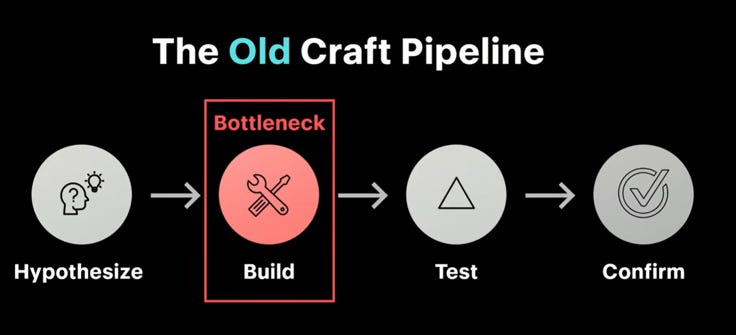
Drug development, clinical protocols, device design. All of it expensive, all of it slow, and all of it bottlenecked at the “build” stage because build requires capital and risk. A lot of it.
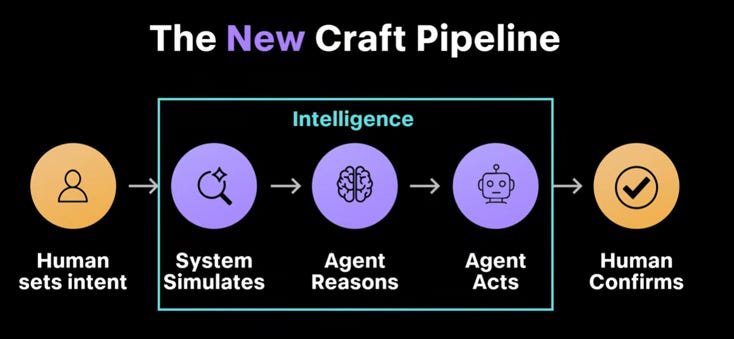
Two technologies are reordering this sequence, and they’re doing it fast.
The first is what Sam calls promptable worlds.
AI systems that simulate complex environments before anything exists in physical reality. Think of what Isomorphic Labs is doing: modeling molecular configurations thousands of times in virtual space before a pipette is ever touched. Build and test swap places. Learning moves to the front of the process.
The second is agentic AI.
Automation follows rules. Agents pursue goals. You give an agent a goal, for example: “find a molecule that crosses the blood-brain barrier and self-degrades within 48 hours” and it reasons across thousands of design options and hands you the five best candidates.
The scientist shifts from designing to selecting.
Now let me translate this for the executive floor.
If your R&D cycle currently runs 10 to 15 years and simulation can compress the early discovery phases by a meaningful fraction, you are not just talking about science. You are talking about time to market. You are talking about patent lifecycle. You are talking about how much of your peak revenue window you actually capture before generics arrive. Compressing even 18 months off a Phase I-ready candidate changes the ROI calculus of your entire portfolio.
But since we are talking about the healthcare market, here comes a side effect: we lose intuition in this transition.
The researcher who spent months failing in the lab didn’t just learn whether the hypothesis was right. They developed a gut sense, some knowledge that lives in the hands, not on a dashboard or a presentation.
When you simulate a thousand iterations before touching physical reality, learning gets faster but also more abstract.
For a portfolio director, this means one uncomfortable thing: the people validating your pipeline decisions may be faster, but they may also be losing the ability to catch what the model can’t see.
Speed without intuition is a risk that doesn’t show up in your Stage Gate scorecard.
How are you designing intuition back into a pipeline that’s being built to run without it?
Pipeline #2 — Discovery: From Observation to Authorship
For most of human history, science observed nature and asked why. Every answer traced back to evolution, to physics. The discovery pipeline was:
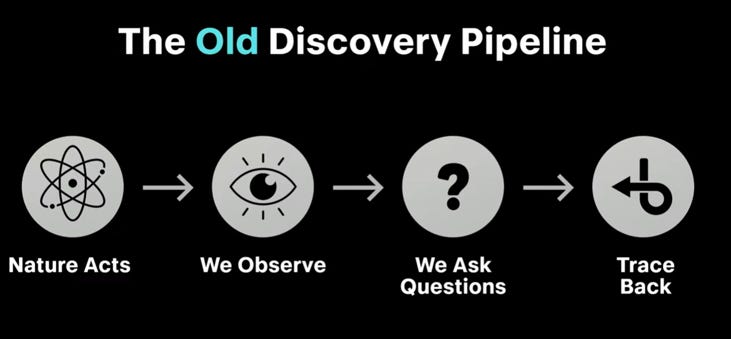
That logic is being dismantled.
Sam points to xenobots. Tiny living constructs built from frog embryo cells, assembled in configurations that evolution never produced, capable of navigating mazes and reproducing through a mechanism that has never existed in nature before.
They weren’t discovered. They were designed. By humans, using AI.
We have stopped asking “why does nature do this?” and started asking “what can we make biology do?”
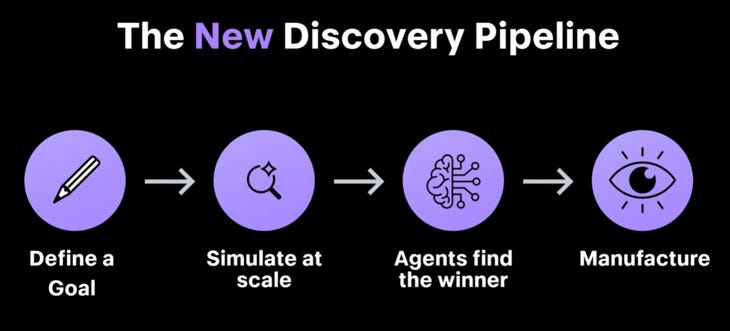
For healthcare, this is the most consequential shift of all.
The era of blockbuster drugs built on broad mechanisms is giving way to something else entirely. Therapies engineered for a specific patient. Proteins designed from scratch. Treatments that don’t generalize, they target. And that changes everything about the business model.
Think about it: the current healthcare revenue engine is built on scale. You develop a molecule, prove it in a large population, manufacture at volume, and run the commercial machine. But what happens to margin (and manufacturing) when the therapy is constructed for 300 patients, not 300 million?
This is not a rhetorical question.
It is the central strategic tension of the next decade for every pharma and medtech executive sitting in a portfolio review. The science is moving toward personalization faster than most business models are designed to absorb. And the companies that don’t build the strategic architecture now, across R&D, commercial, manufacturing, and pricing, will find themselves holding pipelines built for a world that no longer exists.
But Sam raises the other side of this: when scientists shift from discoverers to builders, curiosity becomes a liability.
Anomalies, edge cases, the thing that doesn’t fit the model — those become noise instead of signal. The incentive moves away from exploration.
In an industry where the next breakthrough regularly comes from an unexpected corner of the biology — where a side effect becomes a new indication, where a failed trial reveals a new mechanism — losing institutional curiosity is not just a scientific risk. It’s a risk.
The question here is: Who in your organization is still paid to be curious about the thing that doesn’t fit?
Pipeline #3 — Talent: The Leadership Deficit Nobody Is Budgeting For
This one is the least visible on the P&L. And for that reason, it’s the most dangerous.
The old talent pipeline in healthcare worked like this: junior employees did the difficult, often unglamorous work. They made mistakes. They got corrected.
That friction, over years, built both skill and character.
They earned leadership through exposure to difficulty. Not in spite of it. Because of it.
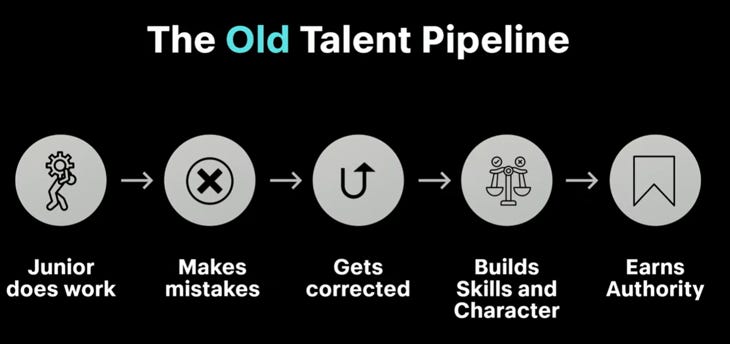
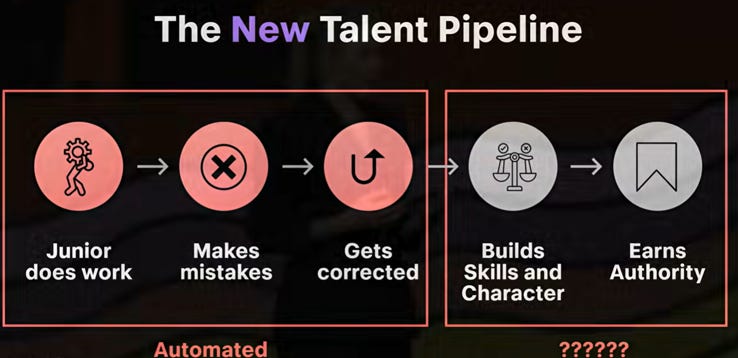
AI is now absorbing large portions of that junior work. The tasks that were the training ground are increasingly handled by systems. And this raises a question that most workforce planning decks haven’t asked yet: if the friction disappears, what builds the next generation of leaders?
Sam shows research that found AI validation makes people more confident and less accurate at the same time.
More sure of an answer that is more likely to be wrong.
In healthcare, where regulatory filings, clinical decisions and safety signals carry real human consequences, this is not a talent development concern. This is a business continuity risk.
And here’s the part that I find most confronting as someone who is building toward a leadership role: the capabilities that matter most at that level (making judgment calls under pressure, holding the line when the data is ambiguous, navigating a board conversation when the portfolio is underperforming) none of those are built in a dashboard or in a chat with a AI. They’re built in friction. In the room where someone you respect tells you you’re wrong. In the quarter where your launch misses and you have to own it.
We are building organizations that are removing that friction at exactly the moment when the technology running through those organizations is becoming more powerful, more autonomous, and more capable of surprising us.
The CEO in Sam’s cautionary scenario understood AI better than almost anyone. But when the crisis came — a structural, human crisis — he could only pull the lever he knew. He announced a $400 million technology upgrade. The press conference went badly. Not because of the plan. Because people weren’t asking about technology. They were asking why no one had listened in the first place.
What kind of leader are you building and what friction is your organization actually providing to build them?
The Friction Audit: Three Questions for Your Next Portfolio Review
Sam closes with a challenge she calls the friction audit.
Map your pipeline. Name what it was quietly producing for free. Then design those byproducts back in deliberately.
For healthcare executives, the three byproducts worth protecting are:
Intuition — built in the field, the clinic, the lab. Not in a simulation. The kind that tells you something is off with a trial result before the statistics confirm it.
Curiosity — the organizational willingness to chase the anomaly that doesn’t fit the commercial model. The thing that has historically been the source of healthcare’s most valuable surprises.
Character — the ability to hold the line when the room wants to move on. To say “I’m not convinced yet” when the agent has already ranked its top five candidates and everyone else is ready to advance.
These weren’t designed into our pipelines. They were unintended gifts from slow, expensive, friction-heavy processes that we are now replacing at speed.
The companies that win the next decade in healthcare won’t necessarily be the fastest. They’ll be the ones with the strategic foresight to keep these byproducts alive inside the new pipelines and the leadership architecture to back it up.
So here’s what I’m sitting with:
Your pipeline is getting faster. Your discovery engine is getting more powerful. Your talent model is getting leaner.
Is the character of your organization keeping pace?
LOVED THIS!! As someone also working for a tech company in the healthcare industry, I'm left wondering how often there will be little to no space for intuition+learning in our processes moving forward, now that we can automate prospecting agents to replace SDRs..
and how spot on you are when mentioning "Character".. in times where people think therapy with LLMs is a valid and constructive option, having HUMANs being able to challenge companies and new policies remains so important, it's scary to think the future creatures we're creating in the lack of it :(